Think Like CJ

Writing Without Lines

About My Blog

I’m CJ. I write about discipline, endurance, grief, and becoming who you are through repetition, not perfection.

  • Daily writing prompt
    Do you have a favorite place you have visited? Where is it?

    During the summer
    I was becoming a junior
    at Indiana University,
    I found myself studying abroad
    in London.

    Breathtaking
    in its truest simplicity.

    Three weeks spent
    wandering the inner and outer edges
    of a city layered
    in history, violence,
    and quiet triumphs.

    A memory that lives unconscious—
    as if the experience
    never fully lived at all.
    London outside me,
    but home
    loud and rattling
    inside my head.

    I was not yet mentally grown.
    A new affection for Jäger and Red Bull,
    a half pint the first night
    turned ritual—
    waiting for the evening hours
    to join the pub-ustery,
    to practice negativity
    until dawn.

    Distracted—

    Counting the days
    until I could go home.

  • Key Song: Lose Yourself — Eminem

    I’m pretty hard to win over.
    I’m a stick-to-what-I-like kind of person, and it takes a lot for something to sway me. So when something actually sticks with me, it sticks.

    Over the last day or so, I’ve started putting together a list of things that have truly helped me along my journey — the tools, books, videos, and templates that kept me focused, grounded, and moving forward. Before this 30-day challenge, I never thought twice about compiling these for anyone to read. But here we are.

    These are the things that showed up for me when I needed them, and maybe they’ll show up for you too.

    Books I Recommend

    • This Naked Mind — Annie Grace
    • The Four Agreements — Don Miguel Ruiz
    • Milk and Honey — Rupi Kaur

    Favorite Videos / Documentaries

    • Iron Cowboy
    • Iron Cowboy: Conquer 100
    • Endurance athlete documentaries
    • Triathlon motivation videos
    • Mental toughness clips

    Applications I Use Daily

    • Strong App — for tracking lifts and progressive overload
    • Trello — for organizing tasks, habits, nutrition, training, and pretty much anything else my brain throws at me.

    My Daily Journal Template

    • 10-minute “all or nothing” brain dump
    • Three positive words to start the day
    • Bible verse of the day
    • Word of the day
    • Quote of the day
    • Three thoughts of gratitude

    Ironman Getting Started Template

    If you’re new to triathlon training or just easing your way into consistency, here’s the weekly structure I use as a foundation. It’s simple, balanced, and sustainable — but still pushes you in all three sports.

    • Monday — Off / Active Recovery
    • Tuesday — Sprint 8 or VO₂-based run + upper body hypertrophy
    • Wednesday — Cycle sprints + swim intervals + core
    • Thursday — Tempo run + lower body hypertrophy
    • Friday — Endurance swim
    • Saturday — Long run
    • Sunday — Long ride or long brick (alternating weekends); optional recovery swim kept light and relaxed.

    These are just a few of the tools and routines that help keep me grounded in a world that often feels chaotic and unpredictable. It’s taken me a while to build a habit of daily journaling and reflection, but it’s been worth every up and down. The world is always a little prettier when you start the day with a fresh thought.

  • Signing up for my first Ironman 70.3 was a small step in a direction I had not quite registered yet. It felt vast and almost ungraspable at first, like I had agreed to something far bigger than the page on my screen. But slowly, through research, trial, and a lot of error, I built a training plan that carried me not only across that first finish line, but through a second 70.3 and even a full Ironman. I did it without a coach, without a certified trainer, and without anyone handing me a perfect blueprint.

    That is not to say I did not have help. I absolutely did, from friends, from other athletes, from people I met at practice swims or on the bike trail, from anyone willing to share even a sliver of their experience. What I learned more than anything is this. You do not need the perfect workout regimen to start training for an Ironman. You only need the heart and the willingness to try, especially on the days you do not feel like it.

    Perfection is not what gets you to the starting line, and it certainly is not what gets you to the finish. The only thing that matters in the beginning is consistency. Give yourself twenty minutes, three times a week. Choose any leg of the race, swim, bike, or run, and simply show up for those twenty minutes.

    No one has ever crossed an Ironman off their bucket list without first reaching for it. Sometimes reaching does not look heroic. Sometimes it looks like lacing your shoes and walking out the door for ten minutes when you wanted to stay home. Sometimes it looks like getting into the pool even when your body feels heavy. Sometimes it looks like pedaling around your neighborhood on a bike that is not fancy.

    All of that counts. All of that matters. All of that is training.

    When I look back at the calendar from my very first Ironman training season in early 2024, I remember how enormous it felt and how every box seemed to carry its own purpose. Rowing intervals. Short runs. Easy rides. Strength sessions. Longer efforts tucked into the weekends when I finally had the time and space to give a little more. I did not see it clearly then, but what I had built was a rhythm. Not a perfect plan. A rhythm steady enough that my life could actually hold it.

    Now when I look at my 2025 season calendar, the structure feels more confident. I know my zones. I understand how to balance intensity with recovery. I switch naturally between strength work and aerobic work. Yet the foundation is still the same as that first year. Consistency, easy efforts, long weekends, rest days placed with intention, strength woven into each week.

    That is the part beginners often cannot see. You do not start by trying to train like someone in year two. You start by learning to follow a simple weekly pattern you can return to again and again. The first year you are learning how to show up. The second year you learn how to trust yourself.

    If you are looking for a place to begin, you can start with a very simple four week rhythm that reflects the spirit of those early months. Nothing overwhelming. Nothing complicated. Just the beginnings of a habit you can build on.

    In the first week, focus on proving that you can show up. Try three short sessions, perhaps a twenty to twenty five minute bike ride, a twenty minute walk or jog, and a short swim or row. If you have the energy, add an easy weekend walk or ride. Nothing needs to feel difficult yet.

    In the second week, add a little structure. Keep the same routine, but let one workout include a tiny progression such as a few short pickups on the bike or a focus on calm breathing in the pool. You will be surprised at how quickly your body adapts.

    In the third week, allow one workout to grow slightly. Perhaps a steady thirty minute bike ride instead of twenty five or a run that finishes with two minutes that feel a little stronger. You are not trying to go fast. You are learning that you can stretch yourself without burning out.

    In the fourth week, let the shape of triathlon appear a little more clearly. A bike, a run, a swim, each kept gentle and steady, followed by a weekend session that is just ten minutes longer than usual. This is often the moment when people realize they are training without even noticing the shift.

    This simple rhythm works because it mirrors what both of my calendars reveal. Ironman training is not about doing everything at once. It is about stacking small, consistent efforts until confidence begins to rise on its own. It teaches you the feel of a training week, how to balance three sports without overwhelming your life, and how growth happens slowly but steadily.

    Most importantly, it protects you from the trap of believing you must be perfect before you begin. You do not. You begin exactly where you are, even if where you are feels small. With patience and consistency, you become someone who can hold the larger work. That is the real secret of Ironman training.

    I signed up for an Ironman on a whim, a silent cry for help, a way to hold onto something without having to actually hold it. I had no idea what I was doing. When I look back at that version of myself, I wish I could lean close during one of those early cycle days and tell her that it will all be worth it. I would tell her not to fear the unknown, not to assume she is failing simply because she feels lost. Time in the saddle is what matters most. Not pain. Not indulgence. Not perfection. Just time. The rest of it finds its way.

  • Daily writing prompt
    Are you more of a night or morning person?

    There’s something prominent about the silence of the morning. Hardly a noise in any direction. Lights are dimmed, humans are nonexistent, and for once the world isn’t as needy.

    The morning carries an urgency for optimism in its truest form. With coffee brewing in the distance and the sun beginning to peek through the clouds, the early hours feel wide open and opportunistic.

    Darkness behind an evening door feels nothing like darkness behind a morning one. Mornings greet you with dew, moistened windows, and the single warm note of a bird chirping somewhere you can’t quite see.

    They’re my favorite because they smell like the earth before the day washes it over with its noise and toxins. Mornings feel renewed, never rushed and always still.

    Depression doesn’t find me in those early hours. It is nocturnal by nature, preferring shadows and corners and slipping into the mind more easily at night. But morning brings light, a soft compassionate light, and for a moment that is enough.

  • Opening:
    I’m excited to share two things that I’ve been passionately working on: a 30-day blog engagement challenge and an upcoming mission that is very close to my heart—my “Carry Their Names” walk around Indiana.

    30-Day Blog Engagement Challenge:
    For the next 30 days, I’ll be publishing daily content designed to connect, inspire, and engage with you—my readers. This challenge is about more than just posting; it’s about creating meaningful conversations, exploring new ideas, and building a stronger community here on my blog. I’ll be experimenting with new formats, sharing personal stories, offering tips and insights, and asking for your thoughts along the way. I invite you to join in: comment, share, or even suggest topics you’d like me to cover.

    Carry Their Names Walk Around Indiana:
    Following the blog challenge, I will be undertaking a mission I’ve felt called to for a long time: walking around the perimeter of Indiana in honor of those impacted by ALS. This walk is a way to raise awareness, honor lives, and bring our communities together in remembrance and support. I’ll be documenting the journey, sharing stories, and connecting with family, friends, and supporters along the way.

    Call to Action:
    I hope you’ll follow along with both the blog challenge and my walk. Engage with the content, share your own thoughts and experiences, and if you’re inspired, consider supporting the mission or spreading awareness. Together, we can make these 30 days and this walk meaningful—both online and in real life.

    Closing:
    Stay tuned for daily updates, reflections, and stories. This is going to be a journey of growth, connection, and remembrance, and I’m so glad to share it with you.

  • Name your top three pet peeves.

    A litter bug—someone who scatters their waste across the world as if the earth were not the very thing holding them up. I will never grasp the mind that wounds its own home.

    A person who cannot speak with emotional intelligence—who stumbles through connection as if feelings were foreign terrain. The world is already heavy; moving through it without understanding yourself or others turns life into a storm without a compass.

    And lastly, those who forget that we shape our own lives. Every dream, every desire, every quiet hope is molded by the choices we make each day. To drift through life unaware of that power… is a tragedy dressed as carelessness.

  • Courage is not being afraid, it’s being afraid and doing it anyway.
    —Gina Bianchini

    My Ironman story didn’t start with confidence or a lifelong dream. It started on a cold December day in 2023, when everything in my life felt like it was caving in. I was depressed, broke, drinking again, newly heartbroken, and drifting through my days in that numb way you do when you’re just trying to make it to the next hour.

    I texted, “I’m gonna sign up for Muncie Ironman,” and then I did. It wasn’t bravery or ambition. It was stubborn, reckless hope, a need for something bigger than my mess. Something to pull me out of the dark. Not to win, but to try. To stick to something.

    I had no coach. No one telling me what to do, no structured plan, no professional guidance. I relied on research, trial and error, and the advice of a few mentors who helped me navigate when I felt completely lost. Every training season, every adjustment, every mistake was mine alone to figure out.

    I had no proper gear. I ran my first miles in ragged Walmart sneakers. Every step reminded me that all I had to give this dream was heart. Halfway through training, friends at my home gym pooled money for my first real pair of running shoes, Brooks Adrenalines. Lacing them up felt like a small gift of belief I hadn’t yet given myself.

    My bike was a hand-me-down Trek, way too big for me, until a mentor gifted me a men’s Fuji to get me through my first Ironman. After that race, she surprised me again with a red women’s Fuji that fit perfectly, but this time it was mine to keep. My tri suit was a hand-me-down, my wetsuit a last-minute Marketplace find. Nothing matched. Nothing was fancy. But every piece of gear told the same story. People believed in me long before I did.

    I trained through every season while working an 8–5 job. Mornings became ritual; evenings were spent running or pedaling until dark. Sometimes I squeezed in a swim at lunch. I was juggling training, exhaustion, and a life unraveling behind the scenes.

    The hardest part wasn’t the miles. It was the doubt.

    Am I doing this right?
    Can I do this?
    Am I strong enough?

    Tears came mid-run more than once. I wasn’t just training my body. I was wrestling with everything broken inside me.

    After Muncie, I expected the high to last. Instead, I crashed. Months passed without running. Another race felt too big, too expensive, too uncertain. Slowly, I learned that the universe meets you halfway when you keep showing up. Small sponsorships, gear, encouragement reminded me that consistency, not perfection, moves you forward.

    The three months before Ironman Arizona were the hardest yet. After a slowdown post-Louisville, I carried more insecurity than ever. I wasn’t counting down to a half anymore. I was facing the full Ironman. Every workout felt heavier. My body begged for rest. My mind questioned everything. But my tribe, friends, family, mentors, never wavered. They poured belief into me when my tank was empty.

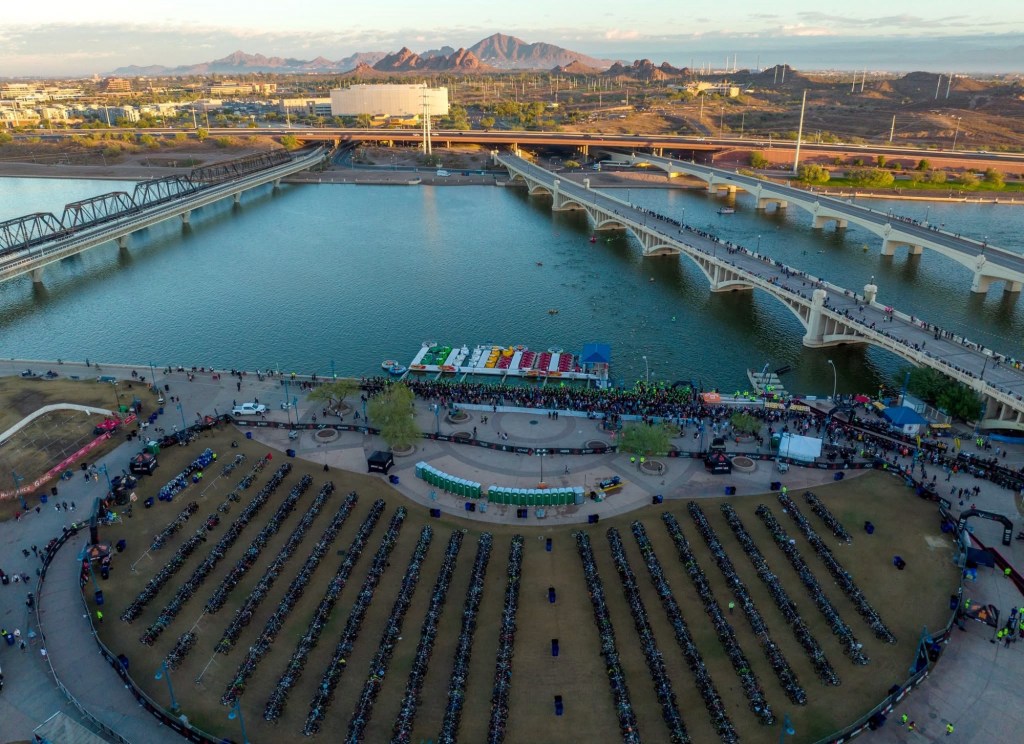
    The swim. Nerves had me putting my wetsuit on backwards in practice. “Good to get those race-day nerves out of the way now,” another athlete said with a smile. Race day water temperature was 67 degrees, cold enough for a wetsuit but warm enough that booties weren’t allowed. I needle-dived feet first into the Tempe Salt River and started the 2.4-mile swim. The straightaways felt endless, and the pull of the wetsuit was a constant reminder that I was moving forward.

    The bike. The course looped through canals, landfills, desert stretches, and brutal winds that knocked me sideways. Moments came when I wanted to stop more than to continue.

    The run. Unforgiving. Two mental walls, stomach issues, and exhaustion made every mile a fight with myself. By mile 23, I could smell the finish line. The lights, the noise, the cheers, and finally the words I had dreamed of hearing:
    “Carly Smith, you are an Ironman.”

    I crossed the finish line twice, once for the crowd, and again when I rang the first-timer’s bell under the Arizona night sky. Fountains sprayed. The arch glowed. It was surreal, overwhelming, and the closing of a chapter I’d once been too broken to imagine beginning.

    Muncie built the foundation. Louisville gathered the pieces. Arizona fused them together. Those finish lines didn’t change who I was. They revealed who I had been all along.

    If this journey taught me anything, it’s that the impossible is rarely impossible. It waits for you on the other side of fear, self-doubt, and the belief that you’re not worthy of doing something extraordinary.

    You don’t have to feel ready.
    You just have to say yes.
    And take one imperfect step at a time.

    Whether you think you can, or you think you can’t – you’re right.

    —Henry Ford

    When people ask me if I would do it again, I think about the challenge. The thing is, the challenge never changes. First Ironman, personal best, every race, it is always me versus me, my limits, my doubts, my perseverance. And that is exactly what makes it worth it. Just like courage isn’t the absence of fear, this race isn’t about ease. It’s about showing up anyway.

  • I sought the Universe, and it heard, and it answered.

    I was baptized on March 31, 2024. I was submerged in holy water and lifted back into a world. This world suddenly felt rebuilt around redemption and second chances.

    At the time, I was drinking again. I was hurt and patched my wounds with temporary bandages. I chased answers that maybe weren’t meant to be understood. These answers instead cracked me open and led me to transformation.

    For a long time, I tried to fit my love for the Universe into a “Christian-accepted” box. I tried to label it, explain it, make it comfortable for the beliefs around me. Over this past year, through unraveling and rebuilding, I realized something:

    The Lord Jesus Christ can be whatever you need Them to be.

    The Lord is the Universe.
    The Lord is the Unknown.
    The Lord is Allah.
    The Lord is Buddha, Nirvana, Peace, and Prosperity.

    The Lord is the strength it takes to get out of bed when life feels impossible.
    The quiet push to keep going when every part of you wants to give up.

    Prayer is not just religion; it is alignment.
    It is the moment you speak out loud your hopes, fears, truths, and dreams.
    It is a way to get right with your body, mind, and spirit.
    It is a way to touch the Universe and say, I’m here. Keep me here.

    And the Holy Spirit is that surge inside you. It is that flash of knowing when your body remembers it is connected to something beyond flesh. It goes beyond circumstance. It extends beyond right now.

    Religion controls the minds of enemies. It shapes the opinions of our closest friends. It also shifts the way we connect with each other. I find myself asking:

    When did faith take on such a twisted burden?
    When did something sacred get bent, stretched, and repurposed to serve politics, power, and the times instead of the soul?

    Religion is not the bad guy.
    Our interpretations are the issue. We twist them to fit fear, control, and ego. These actions have welded negativity onto a universal God.

    God did not cage us.
    We built the cage and then blamed God for the bars.

    I heard someone say once that we die twice.
    First, when our body stops breathing.
    Second, when the last person speaks our name.

    If that is true, then the soul outlives the body.
    It lingers.
    It travels.
    It stays long after our physical form fades.

    Part of my spiritual awakening has been accepting the mystery and acknowledging that we do not know what comes next.
    Maybe we reincarnate.
    Maybe we watch from above.
    Maybe we appear in the moments our loved ones need us most. We are a warmth. We are a presence. This is a feeling that can’t be explained but can be felt.

    The soul, like Christ and the Universe, is memory.
    It is vibration, echo, residue.
    It is every moment we touched this earth. It is every life we brushed against. It is every wave our existence sent out into the world.

    It is what remains when nothing else can.

    In the end, it is whatever you need it to be.

    And so is the Lord.

  • I woke up mid-hurl.

    “Ghhk—hurrrk—bleeehh.”

    My head dangled off the edge of the bed as acid and remnants of dinner splattered the floor. I didn’t even wake up at first. My body purged while I was still unconscious, limp, drunk, helpless. At some point, I found myself slouched in a kitchen chair, hunched over the sink, naked from the waist down, a blanket wrapped around me because I’d pissed myself.

    Cold water splashed over my fingers. This was the only way to stay hydrated during these situations. My body dehydrated fast. I waited for the next round of uncontrollable vomiting, unable to stop the way my body convulsed. Part of me was numbing out, low potassium, no food, no rest. The sickness ran the show, and I was the main character.

    Have you ever paced your house with a dog bowl in hand, gagging involuntarily while your body expels poison on its own schedule? I have. More times than I’d like to admit. My hangovers started in college. That morning was just another chapter in a long, messy novel. My body knew the pattern by heart.

    Post-hangover days were worse. I woke up feeling like a grenade had taken aim at my insides. My sternum was sore to the touch. A cough, or even a chuckle, threw me into a fit of aching. My esophagus stung. Even water burned. My throat felt like a raw tunnel, every dreaded sip a painful reminder. Soda burned like a tattoo, etching in the memories, or lack of, from the night before.

    Mind and spirit hit an all-time low. Regret. Self-hate. Sabotage. Flooding my senses. Unable to see the bigger picture, fogged by a longing for reality to disappear and euphoria to set in.

    For years, the urge to drink again showed up within hours, not days. I’d be hunched over the toilet one minute, cracking a can the next. My body reached for booze like it was a friend helping me off the floor. Alcohol understood where I wanted to go. It knew my intentions. It didn’t care. It was full of assurance.

    Hangovers went from lasting a few hours to consuming entire days, haunting the next three. I drank to oblivion, then tried to piece together the night from splinters and fog. Ambushing those who worried about me with slurred stories, glassy eyes, and stitched-together apologies. Alcohol was a good friend for so many years. Until it wasn’t. Until it started taking more than it gave.

    The internal fight to end this toxic relationship began to swarm my vision, fogged with inequity and illusion. I wanted to quit drinking. I did. But my heart wasn’t ready to let it go. The bridge between wanting to quit and quitting was wide enough to stretch back to London.

    Every time I pictured life without the Devil’s juice, it made me sick to my stomach. Quitting drinking floated in my brain for years before I took myself seriously. Hundreds of hangovers and thousands of dry heaves went by before I finally woke up and realized the consequences had been treading behind me all along. Alcohol followed me through college, into adulthood, and tried to sneak into my thirties before I put the fire out. I hit rock bottom. My whole life as I knew it rearranged, turned upside down in a world of despair, heartbreak, and self-hate.

    Depression stepped in where alcohol left off. It would take multiple attempts at sobriety before I could finally claim the title one-year sober. First, eighty-seven days. Then, several failed tries at just fourteen. Finally, thirty-seven. Now, I’m pressing into two years.

    And somewhere in all of that, my heart broke too.

    “You have this weekend, that’s it.”

    The words would echo in and out of consciousness long after September 2, 2023—the day my world shifted. I was in love. So in love that self-sabotage became my defense mechanism. I lost control of myself, my life, my home. I was drowning in self-deception, desperate for reassurance from everything but me. I didn’t realize how much of myself I had already lost.

    It took months after our demise to even begin to embrace the idea of a growth mindset. The cheating had sent me into a spiral of darkness. I obsessed over blame, criticism, and what-ifs. Everything had to be my fault, right? I convinced myself that the love I had for her outweighed the love I had for myself—body, mind, and spirit. I became a victim of my own self-deprecation. Eventually, I learned that it wasn’t love that hurt me. It was how much I loved to hate myself that did.

    Six months of intense Ironman training followed. I spent hours in the gym, pulling dumbbells to my chest as tears fell from my eyes and splattered on the bench that held the weight of my world. The gym became my safe haven. Training for an Ironman tested every part of me. It pushed me past the negative talk, the self-belittling, the lapses in motivation, and every excuse that gnawed at my mind. I wanted to quit so many times. It hurt so bad. But I didn’t stop.

    I woke up at four in the morning on July 12, 2024. It was the beginning of a romantic date with endurance—the ultimate test of mental fortitude.

    Why do an Ironman?

    It’s simple. The pain your body endures is nothing compared to the healing your mind experiences through the process. The hours of training teach you to love yourself, perhaps for the first time. The reward will always outweigh the suffering.

    I’ve seen it in others too: the woman recently diagnosed with breast cancer, the man training real-life Ironmen while battling terminal brain cancer, the woman racing in memory of her late husband, the middle-aged dreamers searching for meaning, the ones quietly fighting invisible battles—and the one whose mother was just diagnosed with stage four cancer.

    The Ironman is more than a race. It’s a conversation between who you were and who you’re becoming. It’s a way to survive heartbreak, addiction, and despair—and to show up for yourself when no one else can.

    “I feel so broken. I don’t even want to be awake all day. It scares me to see what today brings because I don’t want the reality to be that I’m losing her.

    “I hate these fucking emotions! It’s driving me crazy. I’m feeling all this shit. I don’t like being alone in this house. I just sit here in silence, heartbroken. This has crushed me. I have no power in me, dude. I’m so lost. I’m so sad.”

    The Ironman didn’t erase heartbreak. It didn’t undo depression or past addiction. But it taught me endurance, not just in body but in mind. The race became a mirror: if I could survive heartbreak, hangovers, and months of self-loathing, I could endure anything. And in that endurance, I began to love myself.

  • During a long training ride, I passed a girl crying.

    She sat alone at a picnic table alongside the Minnetrista pedestrian path, surrounded by a mountain of books and a sweating cup of something cold. As I rode by, she wiped her cheek, her face blotched red with the kind of pain that instantly pulled me back to devastation.

    I wondered what had broken her open: a boy? a loss? Whatever it was, I felt her.

    Her image stayed with me for the rest of the ride. Excuses ran rampant on an endless day of training — heading home to finish the 80 miles on a spin bike at the Rec, splitting the distance over two days, or stopping at sixty and calling it a strong brick-run day — anything to make the miles move faster.

    Later in the day, I found myself back on the street where I grew up. The driveway to 1525 — now a blue house — once felt much wider. So did the street. I turned right from Macedonia onto the dead-end street that still held the first thirteen years of my life.

    The road felt longer. Before I knew it, I was gliding down the “big” hill my friends and I raced as kids. I remembered the time I jumped off the back pegs of my black-and-red Mongoose, my cousin steering straight toward a parked car, and flew down the hill on my stomach until I skidded to a stop outside my house, skin burning with road rash.

    Later, I’d reminisce with my mom about that era — the Pogo stick years. The screeching springs of that bumblebee-striped stick must still echo through the neighborhood nearly twenty years later.

    I kept riding, tracing the old road toward the open valley at the end — where the wild, overgrown yards had once stood. The trees that once erupted wildly from the ground were gone. The air used to hum with mosquitoes and the smell of damp wood. Now it’s open, bright, breathing again.

    Back then, the trip from 1525 to the end of the road felt like twenty minutes. Today, I was there before I could blink.

    Even as you grow bigger, the world doesn’t seem to shrink.

    It’s only when you return to the beginning that you realize how small it’s always been.