I’ve been carrying words inside me for years, words I never said out loud, words I never wrote down, words that got stuck somewhere between my heart and my throat.
So for the next 10 days, I’m challenging myself to let them out.
Each day, I’ll post a new letter—letters I never sent to people, places, moments, and even parts of myself. Some will be raw, some reflective, some tender, and some angry. All of them will be honest.
Here’s a glimpse at what’s coming:
A letter to my younger self. A letter to alcohol. A letter to my body. A letter to the mirror. A Letter to London…and more.
This isn’t just about looking back, it’s about finding freedom in the words I’ve held inside too long.
I’d love for you to follow along, and if you feel inspired, maybe even write your own “letter never sent.” Share it in the comments, or just keep it for yourself.
Day 1 starts this evening: A Letter to My Younger Self.
Happiness often sneaks in quietly, wearing the faces I love most. It looks like my Momma Greatness, steady and unwavering in her love, and the four-legged companions who’ve wrapped themselves around my heart: Oso Boy, Sassy Girl, Chester Boy, and Opal Kitty. Each one greets me like I’m the best part of their world.
Some mornings, joy starts small. A fresh cup of black coffee. The comfort of my Teddy Bear blanket. A blank journal just waiting to be filled. A brand-new pack of yellow Ticonderoga pencils, and the soft promise of an unused eraser. There’s something about the beginning of a day. The smell of early morning, the poetic hush of rain tapping against the roof.
I find happiness in conversations that stretch out for hours, where honesty sits at the center and nothing needs to be forced. In authenticity, the kind that can’t be manufactured. In stacks of books I may or may not finish, or ever even start. In loud music that drowns out the static. And in the month of December, when everything feels a little more magical.
Comfort has its own kind of joy. Holding hands, the tender surprise of a perfectly cooked ribeye (rare, of course), or the nostalgic sweetness of Banana Laffy Taffy when I need a lift. At the gym, happiness hides in the effort, the sweat, the push, the quiet strength built rep by rep.
Sometimes joy hums softly in the background: the chirp of crickets at night, or the wind kissing my skin as I fly downhill on a bike and everything else disappears. When I return, Oso Boy meets me with wide eyes and a heart that always remembers. The smell of freshly cut grass. A new water bottle. A good night’s sleep. Snow falling in complete silence—these are my quiet reminders of happiness.
There’s nothing loud or showy about this kind of joy. But these thirty things, simple and sacred, are the pieces that weave through the fabric of my life. They’re always there. Waiting to be noticed.
It’s been eleven days since I last showed up here, not because I had nothing to say, but because the words were too heavy to face. This piece is what it feels like to want to write and be terrified of what might come out. A prose poem about fear, creation, and the strange power our own voice holds over us.
I fear my writing.
I arrive at the blank page, ideas consuming every cell of my body, blood rushing through my veins at the thought of those words dancing — wild, untamed, across the page. I begin to type and instantly wish I could regurgitate them. Words I’ve summoned suddenly feel foreign. I erase them. Often, I never start again.
I force silence into my body to avoid confrontation with my own voice. The words frighten me — because though they’re mine, they’re not.
Who are you? The one with everything figured out, mental fortitude steel-like, broken, but unbreakable.
I read back what I’ve created with butterflies swimming through my rib cage, stealing each breath I try to inhale — while red ants corrupt my equilibrium, dragging me into self-deprecation. The rhythm falters. My chest tightens. I want to run.
Sometimes the words are grotesque, but therapeutic. Sometimes they redirect my senses — as if my alter ego took control of my fingers and typed exactly what I didn’t want to say.
I sit, stuck between a million words, orbiting a single person, upholding the world — insatiable from the lens.
Afterward, the reminder disassembles me from the inside out.
It’s like reality points its finger at me, ready to obliterate the made-up I have created.
What derived from Carly became Harley, and then it was CJ.
It was 2001. I’d just turned seven. I was in first grade at Grissom Elementary School—one of the few schools in the area still raising young scholars. Luckily, I’d had a lot of amazing teachers who helped bring me up. Three still hold a place in my heart. One in particular was my first-grade teacher. What a great soul she was to me.
I was an ornery kiddo in her room, though.
We had a check system. If you got in trouble, you’d receive the following in this order:
Warning
One check
Two checks
Three checks
Four checks — which meant a detailed referral and a free trip to the principal’s office.
It wasn’t entirely uncommon for me to receive four checks. You might find that surprising—especially if you saw the look on my mom’s face when she pulled up to the curb and I held up four fingers, proudly letting her know what kind of day I’d had.
The check system used clothespins. When you got one, you’d walk to the front of the classroom, to the blackboard. You’d find your colored smiley face—the one with your name on it—and clip a clothespin to it.
Honestly, the walk to the board felt like a runway to me.
The Class Clown Gets a Karate Gi
I was your typical class clown—mouth that never stopped, attitude loud and confident.
So my parents signed me up for Karate. Gōjū-ryū, to be exact. Something about self-defense and learning “discipline.”
I remember the drive there like it was yesterday. We’d always take the Muncie Bypass—a miniature highway, as I called it back then. I was fascinated by it. The wind in my face, the rush of air, and those wild smells that hit your nose when the windows are down.
We’d turn left on McGalliard from the Bypass—the part that feels more like a highway than a city road. That stretch would take us close to the main light that split the four-way intersection. But before we got there, we’d turn right into a plaza. My Karate studio was in the middle of it.
You could enter the walkway to the front door by stairs on either side, both lifting you about eight steps above the ground. There was a pet store at the corner of the plaza. I begged most nights to go in and see the animals. Some nights weren’t a no.
From Carly to Harley to CJ
My Sensei could never remember that my name was Carly—but he could remember Harley. Then one day, he called me CJ.
Over time, I learned: CJ was my name. Harley was my name when I was in trouble.
My parents loved snitching on my behavior to my Sensei, which usually ended in:
wall sits
bag punches
kata repeats
sit-ups
or worse, sitting out a session
I stayed in Karate until I was about twelve. Eventually, my Sensei started flirting with my mom, and just like that—my time in the dojo ended.
But what a run it was.
Bloody noses. Punches to the stomach that led to me needing chest gear for every sparring session. A second place in Kata. A first place in Kumite at a national tournament. I reached 1st kyu in brown belt—just two ranks away from black—before stepping away.
The name CJ faded after Karate.
A Reintroduction
It wouldn’t return until years later—when I moved to Charlotte, North Carolina, looking for a fresh start in a big city.
I told people back home, “What better time to introduce myself as CJ?”
I wasn’t wrong. CJ became my stamp for the next year. And when I moved back to Indiana in June 2019, it followed me home.
This piece is nearly a decade old. I wrote it during one of the hardest emotional seasons of my life. I’m sharing it now, not because the pain still feels fresh, but because the lessons still matter. Lightning, heartbreak, fear, and growth, they all strike, but they also pass. This is what it felt like to survive the storm.
Lightning is as unpredictable as heartbreak.
Unlike thunder, you never know when lightning is going to strike. Between thunder and lightning, you have about five seconds to prepare yourself for the rumble ahead. Lightning travels much faster than thunder—at 186,000 miles per second, while thunder lags behind at just over 1,000. It’s always a little behind, never quite catching up. And like lightning, heartbreak gives no warning. It just strikes, whenever and wherever it wants.
The experience felt like needles being shoved into my chest, like my heart was being pierced from the inside out. Lightning reminds me of heartbreak in the way it makes me feel. When I see it, my stomach turns, my knees buckle, and my mind races. As a human being, I’m often introduced—willingly or not—to emotions I can’t explain. I wouldn’t call heartbreak a fear, exactly. But when I see lightning now, it feels eerily similar.
Once, I ran back to my apartment while my girlfriend searched for my student ID that had fallen from my pocket while we were cruising IU’s campus on longboards. A storm was building in the distance. I was terrified. I hated lightning, and I couldn’t fathom going back out. But she took off after it anyway while I waited in the lobby of our campus apartment, pacing. I worried she’d get struck by lightning. I worried she’d fall. I worried I’d never see her again.
When a bolt of lightning travels from a cloud to the ground, it opens a hole in the air called a channel. The light collapses, and that collapse creates the sound of thunder. I never expected to fall in love when I did. Love struck me quickly. And when it left, it opened a hole in my heart.
Heartbreak is a part of life, just like lightning is a part of nature. You know that moment where you stand at the edge of your porch, contemplating running out into the rain to roll up your car windows? That pause, that hesitation? I wish heartbreak gave you that moment. I wish there was time to prepare. I would’ve run. I would’ve run so fast. But I didn’t. I stood there. I got drenched. I drowned in it. Five seconds could have saved me a lot of pain.
I think back to the last time I saw her—the day she left me. The day my life changed.
We were in our 2009 Chevy HHR. She was driving me to class. As we approached the four-way stop outside Student Central, she said, “See you after class. I love you.” I got out, rushing across the street because I was running late. I didn’t even kiss her goodbye.
Within five seconds, she turned the corner. I had no idea I wouldn’t see her after class. Decisions are made quickly—sometimes with thought, sometimes without.
I was sitting in Italian when my texts stopped going through. I knew something was wrong. I had a gut feeling. Today is the day, I remember thinking as I walked out of Ballentine and toward home.
But home looked different now. It had been almost a year since the ID went missing.
I called my mom as I walked over the train tracks, just minutes from our lot. A flood of butterflies hit my stomach. I knew. When I reached Terra Trace, I saw the HHR parked outside. She wasn’t supposed to be home. My heart dropped.
I opened the door to our apartment on February 24, 2016. That was when the first needle plunged into my heart. The second? When I found the Dear John letter on the bed—next to my sleeping kitten, Chester.
Months passed. Everyone told me the same thing:
Time heals all wounds. This too shall pass.
I wanted those two sentences to be true. But they weren’t. Not yet.
I spiraled into a black hole.
I wanted to give up on school, family, friends, on everything. I woke up every day with regret. I wondered about all the what-ifs… if there would ever be a maybe again.
Those first few months were the hardest of my life.
I remember the night I tried to walk home from a house party. It was nearly 3 a.m. A storm was rolling in. I was belligerently drunk. I left my friend and wandered alone through downtown Bloomington. I don’t remember the exact thoughts going through my head, but I know I never made it home that night.
I woke up in the ER.
They told me I had been found laid out in a parking garage—covered in vomit, barely breathing. It was freezing out. A stranger must have called 911, but they were gone when the medics arrived. I was so far gone—from life, from myself.
That night I was in a dark place. My grades were failing. My hope was gone. But somewhere deep inside, I still believed, my light was on its way. I just didn’t know when.
I don’t see heartbreak anymore when I see lightning. The fear is still there, sure—but not the same way. Life is full of lessons, and each day teaches new ones, good and bad.
The five seconds between lightning and thunder taught me that no matter how quickly things change, there’s always a moment, a split second, when you can choose. Shift. Stay. Go.
Someone once told me:
“A lot of positive things can happen in five seconds. Storms wash away the pain so the sun can shine again. Lightning is scary—but living in fear is scarier.”
I’ll never run for five seconds again. Not even in a storm.
This is a longer piece. I wrote it after my mom asked me why so much of my poetry circles around depression. I didn’t know how to answer right away — so I wrote my way through it. This isn’t a cry for help. This is just my voice, speaking honestly.
Indiana’s Cardinal Greenway
Not too long ago, my mom and I were sitting in the garage. I’d recently decided to engage in poetry more, considering most of my work revolves around prose and nonfiction. That day, I read a few of the poems I’d written over the past few days. She enjoys listening when I read. She says I can do spoken word well.
One of the poems I read was titled Habit.
It wasn’t particularly about me and a habit — more so the overarching act of one. I was trying to write about the reason we keep going back. Why we repeat. Why we return.
After I finished, my mom asked me: “How come all your poetry seems to be about depression? It sounds like you’re still depressed.”
I sat with that for weeks.
She’s not wrong. A lot of my writing does orbit around depression, though not intentionally. It’s just a topic my mind returns to, like muscle memory. It feels ever-present, both outside and inside me. Depression is a never-ending sequence. There are days it feels far away — so far I almost feel free. But it only takes a second for the feeling to circle back, preparing to land again.
I’ve never really categorized my writing as depressing. The intricacies I explore aren’t caged within depression — they’re engaged through it. Depression is a style I wear over my naked body. It covers the scars I carry from dragging it through years of mental disaster and deliberate sabotage.
I sweat depression when I work out. I sniffle depression when I’m sick. I scoop it from my plate with a fork when I eat. I swipe it when I pay for groceries. It plays in the back of my mind like the footsteps of the unknown figure in my dreams. It props itself up on the saddle that bellows over my shoulders. I wear it with confidence.
Comparatively speaking, life hasn’t felt incredibly heavy for a few months now. That’s not to say life has gotten easy. It hasn’t. It’s just become… bearable. I type that with a grain of salt — these things often shift in an instant.
I may not be living from depression right now, but my core comes from it. It’s still boiling beneath me, always attempting to rise and engulf. Depression lives inside me. It sprouts between every line I write and winds through each sentence, showing itself in its purest form.
Without warning, it invades my creative brain. It forces me to view the world from a cracked lens. This lens is one I’ve spent my life learning to see through.
Depression may control the pen I write with, but I control where the pen goes next.
It resides in my voice. It’s cracked the foundations that once held me upright. It crashes through my senses like a bowling ball chasing pins, full force.
Yet I still write.
I write alongside my ongoing depression — not from sadness, but from a place of strange joy. Joy in the way I’ve learned to accept the upset. Joy in the way I believe in the Unknown, despite the weight I carry. Joy in the movement of my gears, still turning, even when I feel entirely consumed.
Aside from my mom and her heroic instincts, depression is all I’ve ever known. It’s been the safest zone in every danger zone I’ve entered. It follows my every move, haunting me like a shadow that sneaks behind during a dark night.
Depression is the friend who walks away, only to return with a bow and arrow aimed at the heart.
It is my favorite song. It sings in my ears with a melody I can’t forget. The words twist and turn in front of my eyes, building figurines, sketching darkness across my sight.
Jesus Christ calls it the Devil. Me — I call it your alternate self.
With Ironman Muncie just days away, I wanted to share the piece I wrote earlier this year about how this journey started for me. It’s about more than just a race — it’s about recovery, perseverance, and finally learning how to breathe again.
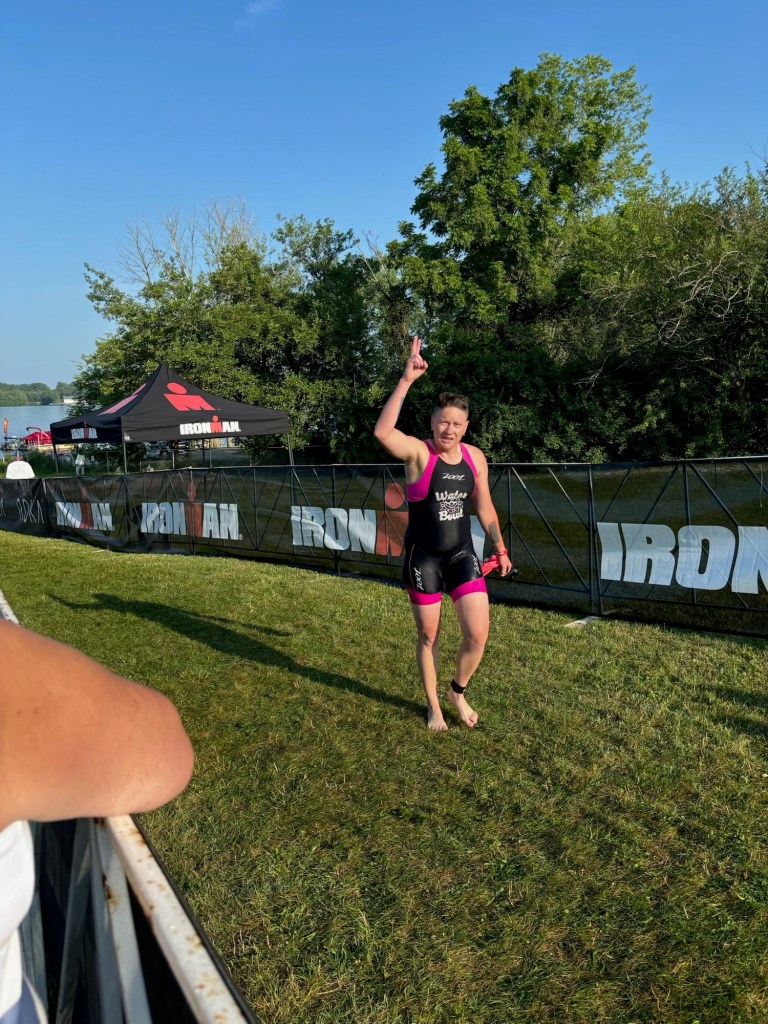
This photo was taken after exiting the swim portion of Ironman 70.3 – Muncie, IN
I’m not usually someone who jumps into relationships. But after the sudden, brain-altering breakup with my fiancé, I found comfort in a girl I barely knew. We dated for three months—no real plans, and somehow, timing was always just a step behind. When it ended, we both quietly erased it from memory. Yet that stretch of time left a lingering ache I couldn’t shake. I was carrying more pain than I realized.
“I’m going to sign up for an Ironman,” I told her one day. I hadn’t intended the words to mean much, but the seriousness in my voice surprised even me.
The idea came from a Facebook ad—something about Muncie being one of “America’s best hidden gems.” I’d been a lifeguard years before, but I had never seriously considered doing a triathlon, let alone an Ironman.
Then I came across a book that suggested writing a short-term bucket list. Without hesitation, I wrote down: Ironman 70.3. Just like that, the decision rooted itself in my mind. Immediate. Immovable. It would be my first Ironman, my first triathlon, and my first race since high school cross country. I was electrified.
Very quickly, my brain became a hostage to this new mission. Ironman infiltrated everything. I obsessively researched dozens of training plans, not following one exactly but stitching together parts from many to create a personalized blueprint. It wasn’t just a goal—it was a lifeline.
By January, I had a detailed workout plan written out through race day: July 13, 2024. I revised it constantly. My right middle finger still holds the indent from all the pen pressure. My obsession wasn’t about perfection. It was about completion. I needed to prove to myself that I could follow through on something bigger than me. The world felt chaotic. My mind, frayed. But this goal, this quest, became my clarity. It didn’t just distract me. It calmed me. It made me feel awake.
Each day, I anxiously awaited the official start of my training. I made sure everyone around me knew it was coming. The encouragement I received only amplified the anticipation, like adding kindling to a fire I had no intention of putting out.
February 13, 2024, arrived faster than I could swallow the previous evening’s dinner.
Because winter pool access was limited, I decided to incorporate rowing into my plan. It wasn’t perfect, but it helped strengthen my shoulders and mimic the movements of freestyle—at least enough to get me started. By March, I could row for 45 minutes without stopping. By April, I was in the water at the Water Bowl, testing the freestyle stroke that had once been good enough to pass my lifeguard swim test.
I couldn’t breathe. Not properly, anyway. I probably looked like a panicked fish, surfacing every few seconds—either because of the water rushing up my nose or the sheer absence of oxygen in my lungs. It was humbling. Embarrassing, even.
I spent hours watching YouTube tutorials on how to breathe, how to glide, how to not completely flail. Eventually, after weeks of starting and stopping, sinking and gasping, I swam my first 50 meters across the Water Bowl without touching the ground or yanking my head out of the water for air. It wasn’t graceful, but it was mine.
I’d joined a Facebook group called Ironman Muncie Indiana 2025, a digital pocket of strangers united by a common obsession. Many were experienced triathletes. Some were just starting out. A man named Don, who I’d later come to see as a mentor, introduced himself and offered help to anyone who needed it. He organized a mock race out at Prairie Creek, the actual race-day course. I agreed to attend, nerves already beginning their slow boil beneath my skin.
“Let’s go!” the guy up front shouted, diving in with a stroke I couldn’t even pretend to mimic. I kept pace for the first few minutes, but quickly drifted behind, my form collapsing with each gasping breath. I treaded water in short bursts, trying to regain control while keeping an eye on the pack moving farther ahead.
Don had marked out a practice loop that mirrored the real race. We were encouraged to complete one lap, with the option to go for two if we wanted to get a feel for the full distance. Even though I was dead last, I went for the second lap, switching between freestyle, breaststroke, sidestroke, and backstroke. Survival mode.
“Hey, no worries. You’re out there, and I’m in here,” one of the volunteer kayakers called out, paddling alongside me.
I had just apologized for taking forever, spewing reservoir water between breathless, self-deprecating comments. Their encouragement steadied me. I turned around the final big yellow buoy and dug deep for the last stretch.
A few hundred yards from the mock swim finish, Don paddled up next to me. He offered to work with me one-on-one.
“We’ll get you stronger,” he said.
Without hesitation, I agreed. That night, I went home and rewrote the final weeks of my training schedule to include regular swims out at the reservoir. But it never got easier.
Each swim left me gutted. Devastated by my lack of progress. Discouraged by the distance I couldn’t yet claim. The pressure of not keeping pace. Of not making the cutoff time. That 1 hour and 10-minute limit haunted me—in my sleep, in the silence before practice, in the cold breath before each plunge.
The motion came to me toward the end of my last practice with Don. I had met him out at the reservoir with a friend of mine who was also competing in Muncie Ironman. She was a swimmer. While graceful for her patience in the water, the waves nearly held me captive. No rhythm. No visual distance. I waddled in place for many minutes before I began to see the trees moving in my peripherals. Sarah, hundreds of feet ahead of me, and Don between us—on alert for discrepancies in our swim—something came over me.
The breath that had seemed imprisoned below my lungs, unable to show itself, suddenly resurrected from my body and almost instantly transformed my form.
Right, left, breathe. Right, left, breathe. I began thinking it in my head as I swam the rest of the way.
“Look at her go!” Don shouted as I neared his kayak.
The excitement in his voice only inspired me to dig deeper. With only a few days before race day, I finally began to feel a sense of control over my swim.
“What are you doing here, Mom?” I asked as I entered Mr. Reynolds’s office, confused by her presence, her expression drained. “I’m leaving your dad. We’ve got to go.”
And off we went, out of Wilson Middle School, straight into her black Bonneville, speeding out of the parking lot and toward our 23rd Street home, where we’d ransack the house in a panic, anxious about Dad’s return.
“Pack a bag with some of your most important things, Babygirl,” my mom said.
Some clothes and my Teddy Bear Blanket were all I needed to feel safe. That, and my mom.
My heartbeat raced, fast, like a river current forced toward the falls that separate the States from Canada.
He didn’t come home that day.
But to this day, my stomach still curls into knots imagining if he had. I can see it: His van turning left into the driveway, tires crunching the gravel. His eyes locked through the windshield. The rush of his feet to the front door.
In my mind, he beats her to it, again. Slams her fingers between the frame and the wooden block, again.
My mom would cry. I would cry.
And maybe, just before all that, I’d hear the sound — pshhhhhloooo — as one of her tires gave out. The kitchen knife slicing through rubber. One tire. Then two. Then all four.
Before he’d go on to destroy every strand of her limbic system.
But he didn’t come home that day. Not then. That time, we made it.