
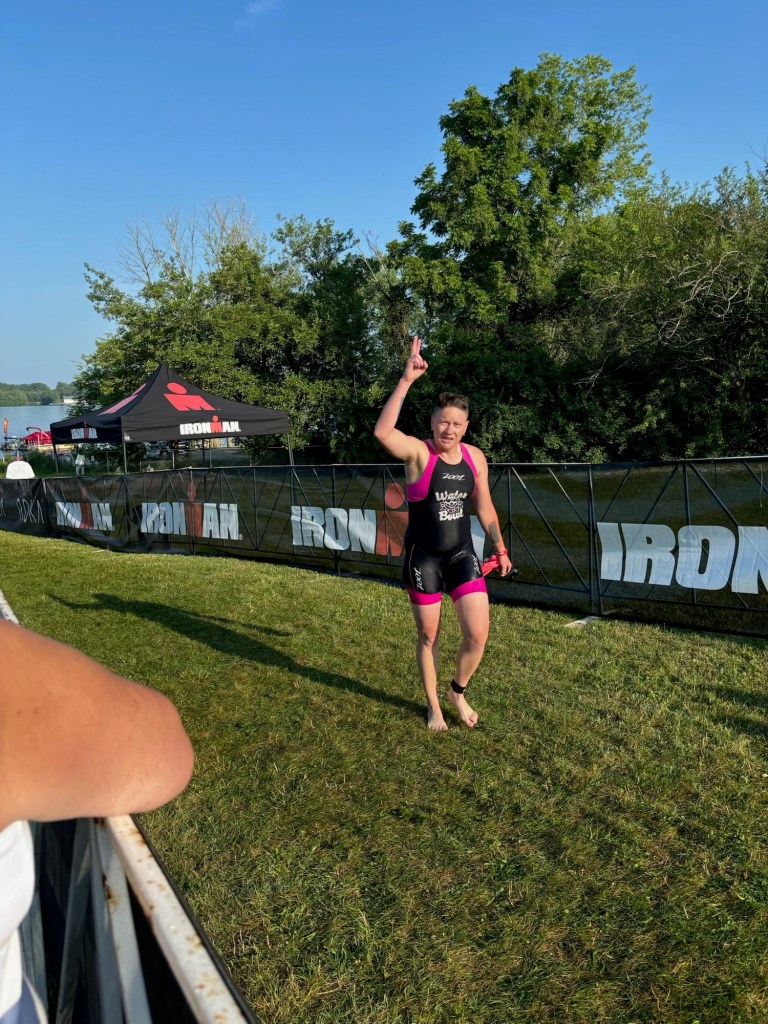
With Ironman Muncie just days away, I wanted to share the piece I wrote earlier this year about how this journey started for me. It’s about more than just a race — it’s about recovery, perseverance, and finally learning how to breathe again.
I’m not usually someone who jumps into relationships. But after the sudden, brain-altering breakup with my fiancé, I found comfort in a girl I barely knew. We dated for three months—no real plans, and somehow, timing was always just a step behind. When it ended, we both quietly erased it from memory. Yet that stretch of time left a lingering ache I couldn’t shake. I was carrying more pain than I realized.
“I’m going to sign up for an Ironman,” I told her one day. I hadn’t intended the words to mean much, but the seriousness in my voice surprised even me.
The idea came from a Facebook ad—something about Muncie being one of “America’s best hidden gems.” I’d been a lifeguard years before, but I had never seriously considered doing a triathlon, let alone an Ironman.
Then I came across a book that suggested writing a short-term bucket list. Without hesitation, I wrote down: Ironman 70.3. Just like that, the decision rooted itself in my mind. Immediate. Immovable. It would be my first Ironman, my first triathlon, and my first race since high school cross country. I was electrified.
Very quickly, my brain became a hostage to this new mission. Ironman infiltrated everything. I obsessively researched dozens of training plans, not following one exactly but stitching together parts from many to create a personalized blueprint. It wasn’t just a goal—it was a lifeline.
By January, I had a detailed workout plan written out through race day: July 13, 2024. I revised it constantly. My right middle finger still holds the indent from all the pen pressure. My obsession wasn’t about perfection. It was about completion. I needed to prove to myself that I could follow through on something bigger than me. The world felt chaotic. My mind, frayed. But this goal, this quest, became my clarity. It didn’t just distract me. It calmed me. It made me feel awake.
Each day, I anxiously awaited the official start of my training. I made sure everyone around me knew it was coming. The encouragement I received only amplified the anticipation, like adding kindling to a fire I had no intention of putting out.
February 13, 2024, arrived faster than I could swallow the previous evening’s dinner.
Because winter pool access was limited, I decided to incorporate rowing into my plan. It wasn’t perfect, but it helped strengthen my shoulders and mimic the movements of freestyle—at least enough to get me started. By March, I could row for 45 minutes without stopping. By April, I was in the water at the Water Bowl, testing the freestyle stroke that had once been good enough to pass my lifeguard swim test.
I couldn’t breathe. Not properly, anyway. I probably looked like a panicked fish, surfacing every few seconds—either because of the water rushing up my nose or the sheer absence of oxygen in my lungs. It was humbling. Embarrassing, even.
I spent hours watching YouTube tutorials on how to breathe, how to glide, how to not completely flail. Eventually, after weeks of starting and stopping, sinking and gasping, I swam my first 50 meters across the Water Bowl without touching the ground or yanking my head out of the water for air. It wasn’t graceful, but it was mine.
I’d joined a Facebook group called Ironman Muncie Indiana 2025, a digital pocket of strangers united by a common obsession. Many were experienced triathletes. Some were just starting out. A man named Don, who I’d later come to see as a mentor, introduced himself and offered help to anyone who needed it. He organized a mock race out at Prairie Creek, the actual race-day course. I agreed to attend, nerves already beginning their slow boil beneath my skin.
“Let’s go!” the guy up front shouted, diving in with a stroke I couldn’t even pretend to mimic. I kept pace for the first few minutes, but quickly drifted behind, my form collapsing with each gasping breath. I treaded water in short bursts, trying to regain control while keeping an eye on the pack moving farther ahead.
Don had marked out a practice loop that mirrored the real race. We were encouraged to complete one lap, with the option to go for two if we wanted to get a feel for the full distance. Even though I was dead last, I went for the second lap, switching between freestyle, breaststroke, sidestroke, and backstroke. Survival mode.
“Hey, no worries. You’re out there, and I’m in here,” one of the volunteer kayakers called out, paddling alongside me.
I had just apologized for taking forever, spewing reservoir water between breathless, self-deprecating comments. Their encouragement steadied me. I turned around the final big yellow buoy and dug deep for the last stretch.
A few hundred yards from the mock swim finish, Don paddled up next to me. He offered to work with me one-on-one.
“We’ll get you stronger,” he said.
Without hesitation, I agreed. That night, I went home and rewrote the final weeks of my training schedule to include regular swims out at the reservoir. But it never got easier.
Each swim left me gutted. Devastated by my lack of progress. Discouraged by the distance I couldn’t yet claim. The pressure of not keeping pace. Of not making the cutoff time. That 1 hour and 10-minute limit haunted me—in my sleep, in the silence before practice, in the cold breath before each plunge.
The motion came to me toward the end of my last practice with Don. I had met him out at the reservoir with a friend of mine who was also competing in Muncie Ironman. She was a swimmer. While graceful for her patience in the water, the waves nearly held me captive. No rhythm. No visual distance. I waddled in place for many minutes before I began to see the trees moving in my peripherals. Sarah, hundreds of feet ahead of me, and Don between us—on alert for discrepancies in our swim—something came over me.
The breath that had seemed imprisoned below my lungs, unable to show itself, suddenly resurrected from my body and almost instantly transformed my form.
Right, left, breathe. Right, left, breathe.
I began thinking it in my head as I swam the rest of the way.
“Look at her go!” Don shouted as I neared his kayak.
The excitement in his voice only inspired me to dig deeper. With only a few days before race day, I finally began to feel a sense of control over my swim.

Leave a comment